Sourdough Class for Beginners: A Hands-On Workshop
Our sourdough class for beginners is hands-on start to finish, so you leave with a live starter, a loaf you shaped, and the trick to an open, airy crumb.
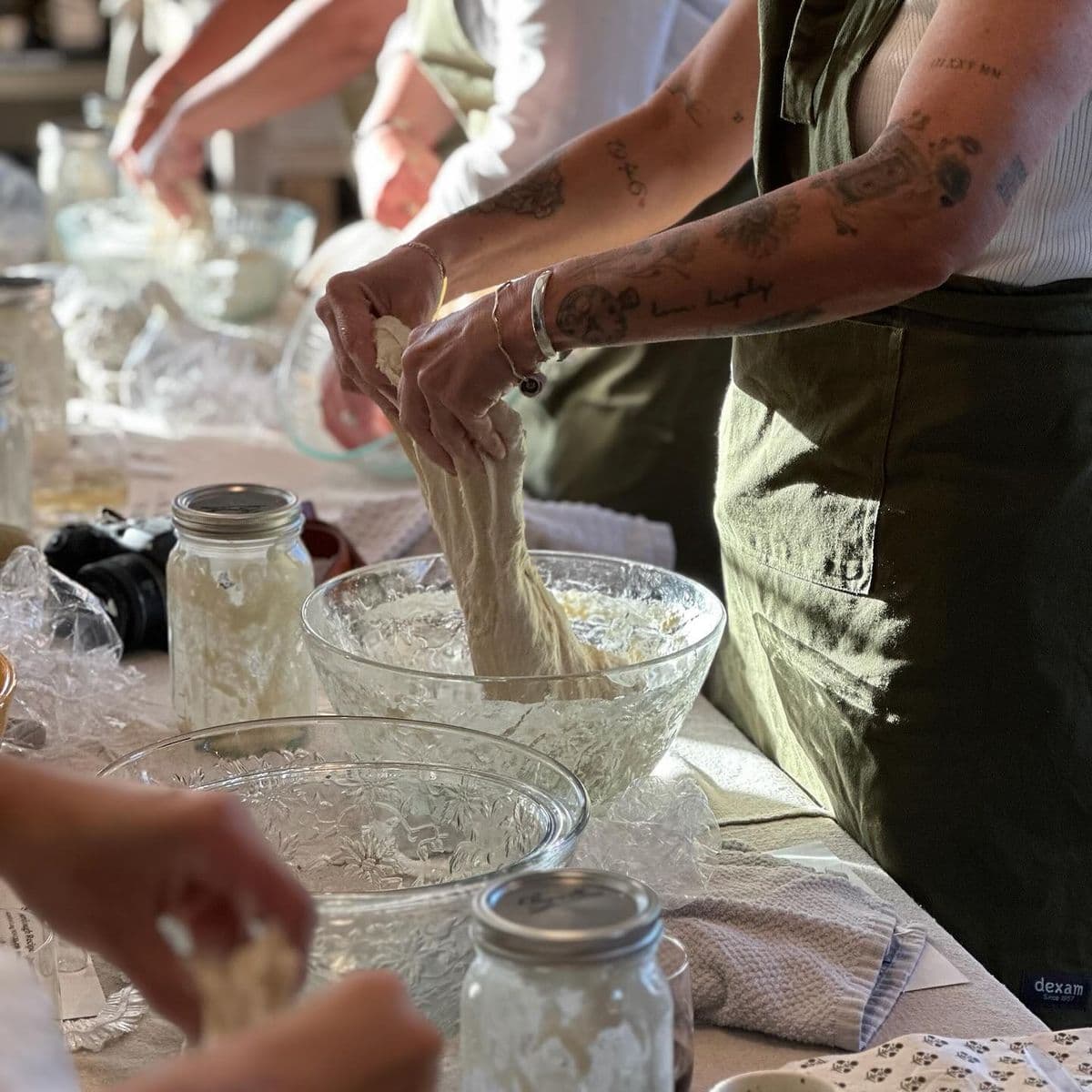
A sourdough class for beginners is a hands-on session that walks you through a whole loaf: feeding a live starter, mixing and folding the dough, then shaping and scoring your own round. You go home with your own active starter and a loaf ready to bake, plus the one thing no recipe can teach on its own, which is the feel of live dough in your hands. Ours runs with Bell's Bakes and is built for people who have never made bread, including anyone who has tried at home and pulled out a dense brick.
Sourdough has a way of humbling everyone, so if it has gotten the better of you, you're in good company. You feed a jar of flour and water for a week, follow a recipe down to the gram, and pull out a pale, dense disc that could prop a door open. We've watched plenty of confident cooks throw in the towel at exactly that point, and we've been right there ourselves. That gap between a perfect recipe and a sad loaf is the whole reason we run this class, and it sits alongside our other hands-on farm classes. It's the one first-timers are most nervous to try, and they almost always leave with a loaf they're proud of.
What does a beginner sourdough class cover?
A beginner sourdough class walks you through the whole loaf, start to finish: feeding a living starter, mixing and folding the dough, then shaping and scoring the round before it bakes. Most of the baking itself happens later in your own oven, because good sourdough takes its slow, bubbly time, so the class puts all its energy into the hands-on steps you can't pick up from a page. Ours runs with Bell's Bakes and keeps your hands busy the whole time. It's not a demo you watch from a stool, and we explain the science in plain language as we go, with no jargon and no quiz at the end.
You're not here to memorize one recipe. You're learning what each stage is actually for, and that's the thing that lets you bake again at home without anyone reading over your shoulder. A recipe tells you what to do. The class tells you why, so the next loaf is truly yours. Scoring is the step everyone underrates: one confident slash with a blade is what lets a loaf open up in the oven instead of bursting at a random seam.

Do you need baking experience to take this class?
No. This is a beginner workshop built for people who have never made bread, and for anyone who has tried sourdough at home and pulled out a brick. If you can stir a bowl and press dough with the heel of your hand, you can do everything the day asks of you.
The class moves at the pace of the slowest pair of hands, which on a given morning might be ours. Plenty of people arrive certain they're hopeless at bread and leave holding the best loaf they've shaped yet. The recipe was never the problem. The missing piece was someone standing next to you.
What does the morning look like, from starter to shaped loaf?
You settle in, then work straight through the loaf: feeding the starter, mixing the dough, a stretch of folding with cozy rests in between, shaping your round, and scoring the top. Somewhere in the middle we stop to taste fresh bread together. By the end you'll have handled every single step yourself.
Folding is where it clicks for most people. On the first set the dough is slack and sticky and you're convinced you've ruined the whole thing. Three sets later it's smooth and holds its shape, and you can feel that it changed right under your hands. The rests aren't downtime. They're when we gather round, talk through what the dough is doing, and answer the questions you didn't even know you had. For the full picture of what to expect on the day, from what to wear to how a farm workshop is paced, we keep a separate guide so this one can stay all about the bread.
What is fermentation actually doing to the dough?
Fermentation is simply the wild yeast and bacteria in your starter eating the sugars in the flour. As they feed, they give off gas that puffs up the dough and acids that build both flavor and strength. Warmth speeds them up, cold slows them down, and that single trade between time and temperature is most of what separates good bread from bad.

We keep the science to what you can actually use. You don't need a chemistry background to feel when dough has come alive. You just need to have felt it once, with someone friendly beside you saying, that's the moment, right there. That part is hard to get from a page, and it's most of the reason the class exists.
Why does homemade sourdough come out dense?
Dense, gummy loaves almost always come down to one of two things: a starter that wasn't quite active enough, or dough that didn't ferment long enough before it went in the oven. Either way, the yeast never built up the gas that opens the crumb. An open, airy loaf comes from a lively starter and dough that has fermented until it's puffed and full of bubbles. The good news is that both are easy to fix once you know what you're looking for.
Two quick checks do most of the work. Before you mix, make sure your starter is bubbly and has roughly doubled since its last feed; if you drop a small spoonful in water and it floats, it's ready to bake with. Then let the dough rise by feel rather than by the clock: you're looking for it to grow by about half to three quarters and turn puffy and bubbly, not for it to strictly double, since chasing a double under-proofs a cold kitchen and over-proofs a warm one. A gentle poke that springs back slowly and leaves a slight dent is another good sign it's ready.
Telling those two states apart is the whole skill, and it's exactly the skill a video can't hand you. We'll put your hands on dough at both stages, the sluggish one and the ready one, so you learn the difference by feel. Most of the dense-loaf problem just melts away the moment you can recognize a starter at its peak. Soon you'll spot it at home too: the domed, risen top of a starter that's ready, set against the flat, tired surface of one that needs another feed before it can do any work.
What do you take home from a sourdough class?
You go home with the two things that matter most: a jar of your own active starter, alive and ready to feed, and the loaf you shaped that day, ready to bake in your own oven. There's no waiting a week or more to grow a starter from scratch. Yours is already bubbling away, and the steps are fresh enough in your hands that you can walk through the whole process again.

That starter is the part that usually stops people before they even begin. Once yours is established, fresh bread becomes a happy weekend habit instead of a project you keep meaning to start. If a warm loaf makes you want to build a whole meal around it, you can go on to cook a full farm-to-table meal with us and bring your own bread along.
Can kids take the sourdough class too?
Yes. Sourdough is a hands-on, family-friendly activity, and kids do real work rather than watching from the sidelines. Small hands turn out to be wonderful at squishing, folding, and shaping, and the mess is half the fun. Children take home their very own starter and their very own loaf, just the same as the grown-ups.
Sourdough is a patient teacher for kids, and it's a gentler way to answer the where-does-food-come-from question than most. If you're booking for a family, the workshop page has the current details to check before you sign up.
Is a sourdough class worth it compared with learning from a video?
A video can show you the steps, but it can't feel your dough or lean over and tell you it needs ten more minutes. A class gives you a real baker reading your loaf right alongside you, a starter already at peak activity, and a finished loaf in your hands the same day. You get to skip the weeks of solo guessing that send most people back to store bread.
You won't master sourdough in a single morning, and nobody expects you to. It takes a handful of bakes at home before it feels like second nature. What the class gives you is the right starting point, so those bakes turn out well instead of teaching you bad habits you have to unlearn later. Free recipes will get you there eventually, after enough discouraging loaves to make you want to quit. A friendly morning with a baker is simply the shortcut.
Whenever you're ready to stop wrestling with your starter, book the sourdough workshopand come bake a loaf with us. And if you're weighing which class to start with, you can browse all our hands-on farm workshops and pick your morning.
Frequently asked questions
No. A beginner sourdough class is built for people who have never made bread, including anyone who has tried at home and ended up with a dense loaf. If you can stir a bowl and press dough with your hand, you can do everything the class asks of you.
Dense, gummy loaves almost always come from a starter that was not active enough or dough that did not ferment long enough before baking. Make sure your starter is bubbly and has roughly doubled since its last feed, and let the dough rise until it looks puffed and full of bubbles rather than baking strictly by the clock.
A ready starter is bubbly and has roughly doubled since its last feeding, usually a few hours after you feed it at room temperature. Many bakers use the float test: drop a small spoonful into water, and if it floats it is active enough to bake with.
You leave with your own jar of active sourdough starter and a loaf you shaped yourself, ready to bake in your own oven at home. That means you skip the week or more it usually takes to grow a starter from scratch.
Only if you keep it at room temperature and bake often. If you bake occasionally, you can store the starter in the fridge and feed it about once a week to keep it healthy and active.
Yes. Sourdough is a hands-on, family-friendly activity, and children do real work like folding and shaping the dough. Check the workshop page for any current details before you book for a family.