Soap Making for Beginners: How Real Soap Gets Made
Soap making for beginners, from a farm that makes its own: how saponification works, the truth about lye, and why your first batch shouldn't be solo.
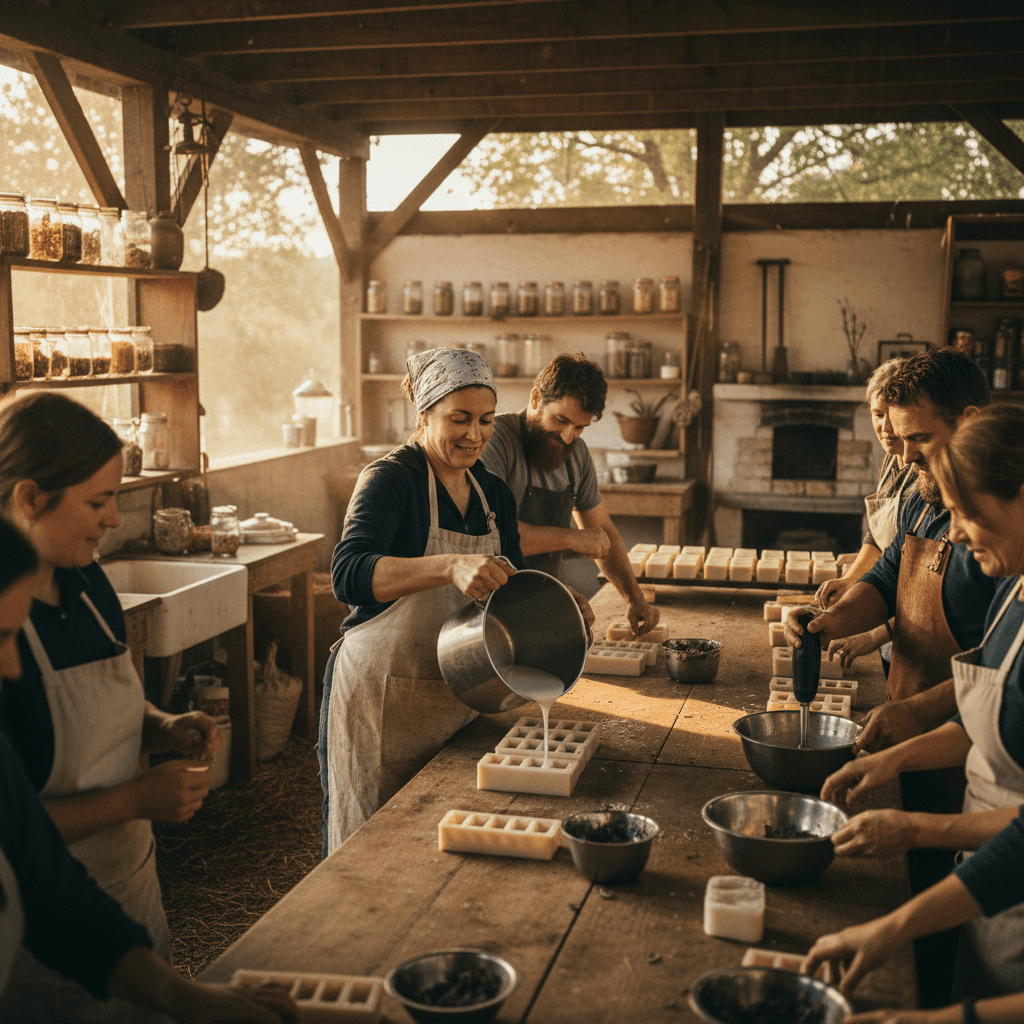
Everyone who picks up a bar at the farm shop asks the same two questions: "did you make this?" and "isn't lye dangerous?" Yes, and yes-but-calmly. The internet has done a number on beginner soap makers: every tutorial leads with the word caustic and then wonders why nobody finishes the article.
This post is the calmer answer. It's orientation, not a recipe — what saponification is, what the lye question deserves, and why a first batch goes better with company. For how soap compares with everything else you could learn first, see where soap sits on the beginner's skill ladder.
How soap gets made, in plain words
Soap is what happens when fat meets lye and both stop being themselves. You dissolve lye in water, blend the solution into oils, and stir until the mixture thickens to what soapmakers call trace — the point where a drizzle leaves a faint trail on the surface instead of vanishing. Then you pour it into a mold and walk away.
What happens next is the part people don't expect: the chemistry keeps working without you. Over the following days, saponification turns the fat and the lye into soap and glycerin. Both ingredients get consumed. Properly made and fully cured, the bar contains no lye at all. The lye did its job and left.
The lye question: dangerous, or just respected?
So is it dangerous? Our honest frame: lye (sodium hydroxide) deserves the same respect as a hot oven or a sharp knife, and you already own both.
The rules are short. Gloves and goggles on. Add lye to water, never water to lye. No kids or dogs underfoot while lye is out of its container. Mix somewhere ventilated and don't lean over the bowl. Follow those, and what you have isn't a hazard; it's a procedure, done calmly, like draining a pot of boiling pasta.
We've watched plenty of first-timers arrive with lye nerves. One kept her gloves on through the snack break, just in case. The fear mostly dissolves the first time you watch someone unhurried do it — which is, not coincidentally, an argument for learning next to that someone.
Cold process vs melt-and-pour
Can you make soap without lye? No. There is no true soap without it; the chemistry is the definition.
What you can do is melt-and-pour: a pre-made base that someone else already saponified, which you melt, scent, color, and re-mold. It's a lovely craft and a good rainy afternoon with kids. Just be clear-eyed about what it is: decorating soap, not making it. Cold process, the lye kind, is the one where you start with oil and end with something that didn't exist before.
What you'd need to start at home, and what it costs
The home kit-out, before any oils: a digital scale ($15 to $25, and it must be a scale — soap is weighed, never scooped), a stick blender ($20 to $30), lye ($10 to $15), a thermometer, goggles and gloves, and a mold, which can be a lined loaf pan. Call it $60 to $100.
Is it cheaper to make your own? Not at first. Your first bars will cost more than the nice ones at a farmers market, the way the first tomato from a new garden always costs more than the store's. The economics only work if you keep going. Most of that kit lasts for years, though; after the first batch you're only buying oils and lye.
Why farm-made soap is different
Small-batch soap differs from the supermarket bar in ways you can feel by the second week. The glycerin that saponification creates stays in the bar; large manufacturers often pull it out to sell separately. A slow cure makes a harder, longer-lasting bar. And the ingredients get chosen by a maker deciding what skin needs, not a spreadsheet deciding what the margin needs.
That's the general case; every maker's recipe is their own, ours included. You can judge the results on the soap shelf in our farm shop.
Mistakes first-timers make going it alone
The failures that get people aren't dramatic. Nothing explodes. Instead: a kitchen scale that was off by enough, a trace that got rushed, a recipe scaled badly off a video, a pour at the wrong moment. The bars look fine going into the mold and then never quite harden, or they harden with a crumble, or they weep.
And because the verdict arrives weeks later, after the cure, there's no way to connect it back to the moment things went wrong. So people conclude the obvious wrong thing: that they're bad at it. For what it's worth, cheese making has the same quiet-failure problem. A craft that fails silently is a craft worth learning beside someone.
What happens in a hands-on soap workshop
A first pour with someone experienced at your elbow changes the whole experience. The lye gets handled calmly, because the person beside you has handled it a hundred times. Your scale gets checked before it can lie to you. The trace question (is this it?) gets answered while the answer still matters. And you go home with your own mold, your own batch, and the date you get to cut it.
Soap making comes around regularly on the workshop calendar, with dates and pricing posted there. For the logistics (what to wear, what to bring, whether you'll look silly), the full rundown of a workshop day covers all of it.
Curing, using, and keeping your bars
However you make your first batch, the last ingredient is patience. Cold-process soap cures for four to six weeks: water leaves the bar, the bar hardens, and the soap gets milder and longer-lasting. Yes, you have to wait. Waiting is the hardest skill in this post.
Store curing bars with air around them, on a rack or a slatted shelf, and turn them now and then. Once cured, keep them dry between uses and they'll outlast every bottle in your shower.
The curing rack itself is the reward nobody mentions: six weeks of walking past a shelf of bars you made, the scent reaching you a full room away.