Eating With the Seasons: A Farm-to-Table Guide From Our Fields
What farm to table actually means, and how to eat seasonally without overhauling your kitchen. A year of honest notes from our own 85 acres.
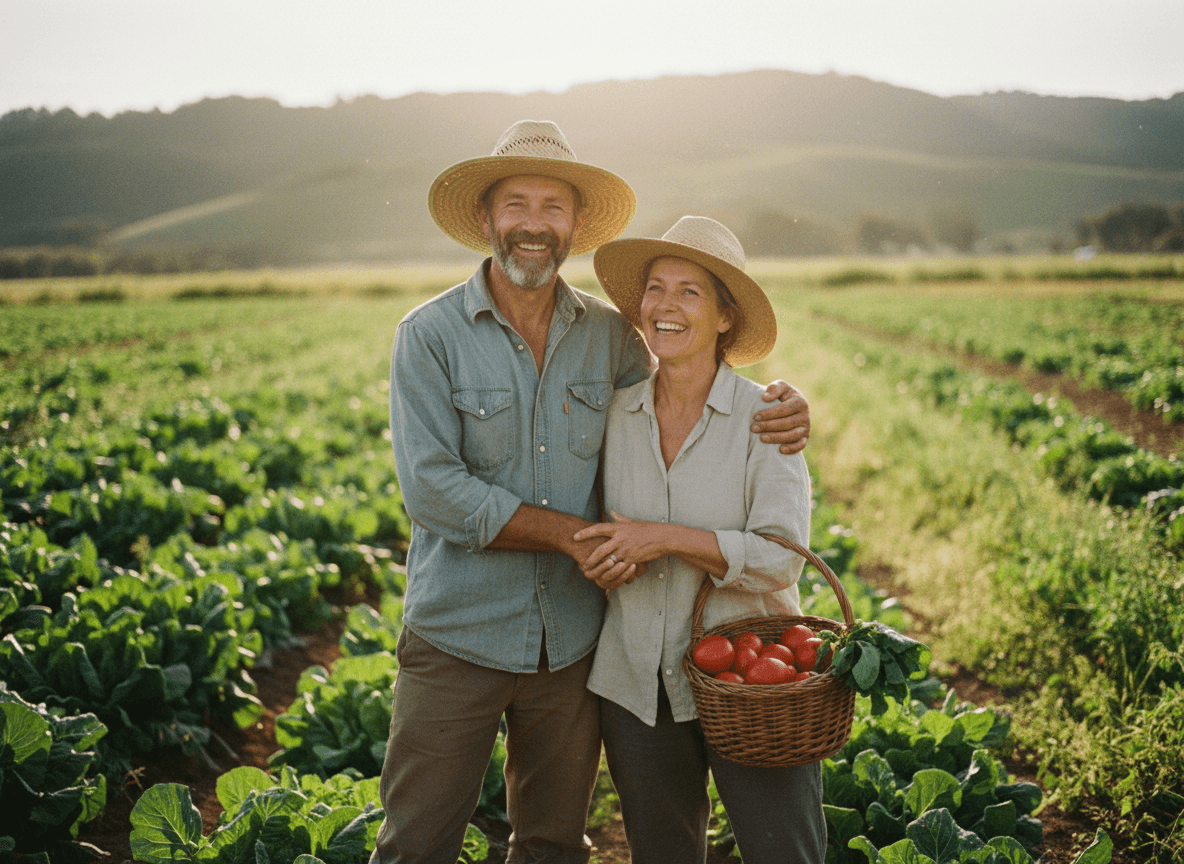
The question we field most at the farm stand is what's good this week, and the answer depends entirely on the month. In April it's spring greens and a short list. By July we can't finish the answer before the basket is full, and in January the honest reply is eggs, honey, and whatever went into storage back in October. That one question, asked across a year, is the whole idea of eating seasonally.
This is the long version: what farm to table means from people who grow the food, what seasonal eating gets you (and what it doesn't), and how to eat seasonally without turning your kitchen into a renovation project. Every season on these 85 acres went into it. It's our year, not a chart.
- What "farm to table" means
- Why eat seasonally: the version with caveats
- A year on our farm
- How to start eating seasonally (without overhauling your kitchen)
- Eggs that didn't ride a truck
- Raw honey, straight from the hives
- Make it last: storing the haul
- What's in season when
- Preserving the glut
- Buying direct: stands, markets, CSAs, and what to ask
What "farm to table" means
Farm to table means food that goes from the farm that grew it to the person eating it, with as few stops as possible. No distributor, no warehouse, no week in a refrigerated truck. You hand us money at the barn; we hand you something that was in the ground, on the tree, or under a hen within the last day or two. That's the whole definition, and it fits in one sentence because it's a supply chain, not a philosophy.
The term has been stretched, and we'll say so plainly because somebody should. Restaurant menus use it for one garnish sourced from within a tank of gas. Grocery marketing uses it for anything photographed near a wooden crate. Nobody checks, so the phrase can mean almost nothing now, which is a shame, because the literal version is worth having and worth asking for by name. When a term can be bought, the only fix is to ask better questions of it.
Ours is literal. The eggs come from the coop you can see from the stand. The vegetables grew in the fields behind a barn that has stood since 1912. When you ask what was picked today, the person you're asking did the picking. The test we'd offer for anyone's farm-to-table claim is a single question: which farm? If the label can't survive that question, it's decoration.
Why eat seasonally: the version with caveats
Three reasons, each with its caveat attached, because we'd rather be trusted than impressive.
Flavor first, because it's the one that isn't close. A tomato picked ripe in August beats a tomato picked green for a long truck ride — every time, on any table. Shipping varieties are bred to survive the trip; ours are bred to taste like something, which is why we grow 50-plus heirloom vegetable varieties that would never survive a distribution center. If seasonal eating has one airtight argument, this is it. Flavor is also the argument children accept without a lecture.
Price is where most farm blogs start fibbing. In season and in glut, farm produce is cheap; when squash comes in faster than anyone can eat it, the price follows it down. Out of season, or for anything fussy to grow, a farm stand is not cheaper than a supermarket, and pretending otherwise insults you. Supermarkets are very good at being cheap. Buy the gluts and you'll save in July, spend more in March, and land somewhere near even over the year. Anyone promising better is selling a newsletter.
Nutrition claims get the most decoration and deserve the least. The short version: differences are modest and mostly a freshness story, since vitamins fade with time off the plant and our produce has had less of it. A local carrot will not fix anything a regular carrot won't. We sell the carrots, and we're telling you that anyway.
The summary we give at the stand: eat seasonally for the flavor, let the savings be a bonus, and walk away from anyone promising miracles.
A year on our farm
Spring opens with the first asparagus cut in May, still tender enough to eat raw, which we do, standing in the row. The hens come back into full lay as the days stretch; when every layer is on we're collecting 18 to 24 eggs a day, and anyone at our own breakfast table gets interrogated about how they like theirs. Greens come in fast, and salad stops being a sacrifice.
Summer is the glut: more squash than sense, tomatoes ripening faster than we can pick, beans that need going over every other day. It's the season people picture when they picture a farm, and for about two months the picture is accurate. The kitchen stops asking what's for dinner and starts asking how much of it has to be squash.
Fall is harvest proper. Apples and pears come off the orchard trees, peppers hit their stride, and the work shifts from picking what's ready to putting away what will keep. Roots, onions, cabbage, squash curing on shelves: the stand starts looking less like a market and more like a pantry. Eating in October means eating with one eye on January.
Winter we won't dress up. The fields rest, the stand thins, and the lean stretch before the first spring greens has an old name: the hungry gap. What carries us through is what stored well, what the hens still offer, and what got put up in August. It's also when the kitchen gets inventive, which turns out to be its own pleasure; by February we are extremely sincere about cabbage. We keep a running diary of what we cook through all this; what May looked like in our kitchen is a fair sample of the genre.
Everything above rotates through the farm shop as it comes in. The list changes weekly because the fields do. That's not a flaw in the system; it is the system.
How to start eating seasonally (without overhauling your kitchen)
You don't need a chest freezer, a meal plan, or an ideology. Three moves cover most of it, and none of them asks you to give anything up.
- Shop the pile, not the recipe. Walk in without a plan, buy whatever there's the most of, then decide dinner. The pile is the farm telling you what's good this week. Recipes can be chosen in the parking lot; they're more flexible than they act.
- Substitute freely. Most recipes survive a vegetable swap without complaint. Chard where the spinach should be, turnips standing in for half the potatoes. The dish comes out slightly different and nobody at the table files a grievance. Soups and roasting pans are the most forgiving places to practice; start there.
- Let the kids pick one thing. Whatever they choose at the stand, they eat, even if it's the weird knobbly one. Especially then. A vegetable a child chose is a vegetable a child will defend, and we have yet to see the trick fail.
If you'd rather learn by doing than by reading, that exists too. Our workshop calendar includes farm-to-table cooking, and the beginner's guide to learning farm skills lays out where to start and what to expect.
Eggs that didn't ride a truck
Supermarket eggs are often weeks old before you meet them — ours were laid this week, usually this morning. The differences people notice, counter storage and deep orange yolks included, come down to age, the bloom on an unwashed shell, and what the hens eat, not nutritional magic. The full comparison, refrigeration rules and all, is in farm-fresh eggs vs store-bought. It settles the hard-boiling question too.
Raw honey, straight from the hives
Raw means the honey was never heated past hive temperature or filtered down to nothing; it keeps its pollen and tastes like the month it was made. Crystallizing is normal, reversible, and a point in the jar's favor. The one hard rule: no honey of any kind for babies under one. For the label fine print and the hive-to-jar story, read what raw honey actually is.
Make it last: storing the haul
Produce from a stand was picked a day or two ago, so you start with days of extra life that supermarket produce already spent in transit. The single rule that protects your haul is sorting counter from fridge; get it wrong and you hand the head start back. The crop-by-crop version, first-hour triage included, lives in how to store farm-stand produce so it lasts. Most of it takes ten minutes on the counter the day you get home.
What's in season when
These fields run on a rhythm: first greens, late-spring abundance, the summer flood, fall storage crops, the long quiet. Knowing roughly what arrives when is what makes the rest of this guide usable on an ordinary Tuesday. The month-by-month produce guide walks the whole year, including the months nobody brags about.
Preserving the glut
Sooner or later the glut wins, and the only move left is putting food up. Three options, in rising order of effort.
Freezing is the easy one. Blanch vegetables briefly in boiling water first, because blanching stops the enzymes that otherwise keep working in the freezer and turn everything to gray mush by February. Beans, greens, and squash all take to it; tomatoes do better cooked into sauce first. Cool, bag flat, label with more detail than feels necessary. You will not remember which bag is which. Nobody ever has.
Refrigerator pickles are the gateway craft. Hot brine (vinegar, water, salt, a little sugar, whatever spices you trust) poured over vegetables in a clean jar, lid on, into the fridge, eaten within a few weeks. We make pickled garlic scapes this way every year, and every year they go fast. No special equipment, no risk, no excuse.
Proper shelf-stable canning is worth learning, and worth learning properly, which means from a tested source or a person who cans, not from a paragraph in a blog post. Including this one. We're telling you the craft exists and is worth your winter; we are not teaching it in forty words.
Buying direct: stands, markets, CSAs, and what to ask
Farm stands, farmers markets, farm shops, CSA boxes: different counters, same idea. A short chain and a person to ask. The asking is most of the value, so here's what to ask.
What was picked today? That gets you the freshest thing on the table, which is rarely the prettiest. What's about to be in glut? That's next week's bargain, and farmers always know. And what do you eat yourself? Farmers are terrible liars about their own dinner. Watch where the seller's eyes go, and buy that. Markets reward the early and the curious; the best of the table is usually gone by ten.
A word on CSA shares, since they're the deep end: you pay up front and receive a box of whatever the season delivers, week after week. If you like cooking from a surprise, it's the best deal going. If you don't, it becomes a weekly guilt delivery. Know which cook you are before you sign anything. Either way, the farmer gets paid in spring, which is when farms need it most.
And if you'd rather meet the food before you buy it, come walk the farm on a Saturday. General admission is $15 an adult, open Saturdays 10am–3pm, and you can stand in front of the hens whose eggs you're weighing.
However you buy, buy where your questions get answered. If that's here, what's on the shop shelf this week is the place to look. Fair warning from a great many Saturdays: whatever we name as this week's best thing will be gone by the time you read this. Something better is usually ripening behind it.