Farm-Fresh Eggs vs Store-Bought: What's Actually Different
Farm fresh eggs vs store bought: the real difference is age, the bloom, and what the hens eat. Honest answers from a farm that collects daily.
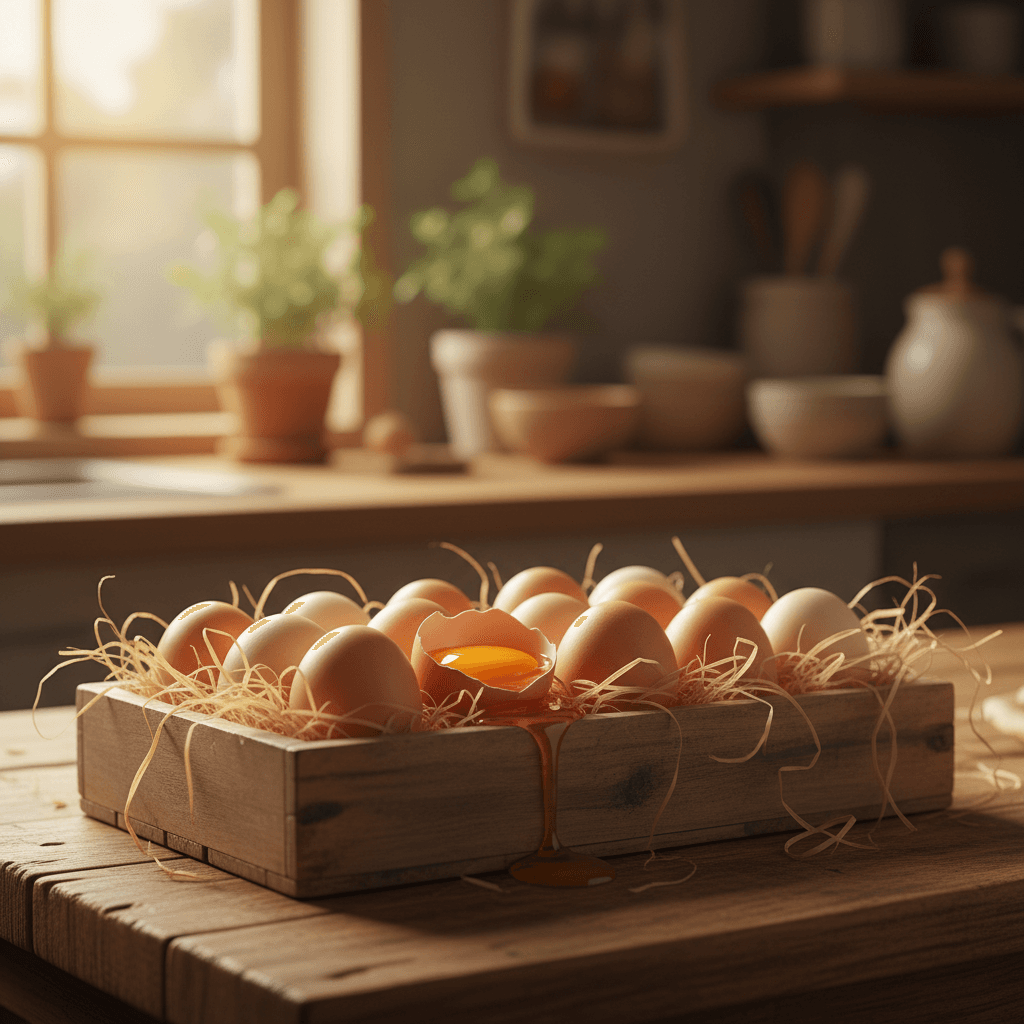
Nineteen eggs this morning, most of them still warm when they hit the basket. We sell them at the stand on Saturdays, which means we field the farm fresh eggs vs store bought question every week, usually phrased as: what am I paying extra for? Fair question. The honest answer is shorter than the marketing suggests.
This post is that answer, from people who collect daily and still buy the odd supermarket carton in deep winter. It's one piece of a bigger habit; our guide to eating with the seasons covers the rest of it.
How old store-bought eggs really are
Supermarket eggs are legal, safe, and old. Between laying, washing, grading, distribution, and shelf time, the carton in your fridge can be weeks past the hen before you crack the first one. Nothing scandalous there; the system is built to move millions of eggs without breaking them, and an egg inside the regulated window is fine to eat. There's no villain in that story, just distance, scale, and time. But fine to eat and fresh are different words. Ours were laid this week, often this morning. Age is the real difference between the two eggs, and nearly everything else people notice flows from it.
The bloom: why unwashed eggs can sit on the counter
Every egg leaves the hen wearing a bloom, a thin natural coating that seals the pores of the shell against air and bacteria. Leave the bloom on and the egg keeps happily at room temperature. Wash it off, which commercial processing here does, and the shell turns porous, which is why store-bought eggs have to live in the fridge. The practical rule is short: once an egg has been washed or refrigerated, keep it refrigerated. An unwashed egg can sit on the counter; a washed one has made a one-way trip to the cold. If you're unsure which you have, ask the person who sold it, or just refrigerate and lose nothing.
Yolk color and firm whites: what the hens' diet changes
The deep orange yolk is the thing people photograph. It comes from the hens' diet: pasture, bugs, kitchen greens, whatever the yard offers that day. Yolk color is a record of what the bird ate, not a secret nutritional upgrade. In spring, when every layer is on and we're collecting 18 to 24 a day, the yolks run darkest because the pasture is at its best. In winter, when pasture gives way to feed, our own yolks pale a shade, which proves the same point from the other direction. The white tells you something too. A fresh egg's white stands up tall and tight around the yolk; a flat, runny white means an older egg. Both are still eggs. One just left the hen more recently.
Are they healthier? The honest answer
Modestly, maybe, depending on the study and on what the hens ate. Pastured eggs show somewhat better fat profiles and more of certain vitamins in some research, and less difference in other research. The dramatic claims you'll read elsewhere, the half-the-cholesterol stuff, don't hold up. Saying so costs us egg sales, and we'd rather lose those than your trust. What you reliably get from a small flock is a fresher egg from a hen whose living conditions you can stand in front of and judge for yourself. If that's worth something to you, good. If it isn't, the supermarket egg will not hurt you, and we'd rather say so than sell you a story.
Cooking differences: where fresh wins (and loses)
Fresh eggs poach beautifully: the tight white holds together instead of feathering into the water. Fried, same story, a yolk that sits up and a white that stays put. Where they're terrible is hard-boiling. The white of a very fresh egg bonds to its shell, and peeling one turns into archaeology. The fix is to hard-boil your oldest eggs, or steam them instead of boiling. We learned this from several breakfasts of cratered eggs that looked gnawed. For baking, use whichever egg you have; the cake can't tell.
How long farm eggs last and how to store them
Unwashed on the counter, a few weeks easily. Refrigerated, a couple of months without drama. Store them pointed end down, which keeps the air cell at the top and the yolk centered, and don't park them next to anything that smells strong; shells breathe more than you'd expect, washed or not. If you buy or collect in quantity, date the cartons, because rotation beats memory. The same put-it-away-right instinct pays off across the whole market bag, which is why we wrote up how we store farm-stand produce separately.
What you're paying for
Small-flock eggs cost more than the cheap carton because everything about them is the slow version: real feed, daily collection by hand, a flock small enough to know individually. You're paying for labor and freshness, not branding. Current price and availability live with eggs in the farm shop; pickup is daily at the farm from 5–7pm, the town stand on Tuesdays and Thursdays, or Saturdays during farm hours.
Quick freshness checks
Put a doubtful egg in a bowl of water: it lies flat when fresh, tilts as it ages, and floats when it's done, and a floater goes to the compost. If a cracked egg smells wrong, it is wrong; no second opinions. And if all this has you eyeing a corner of the yard for a coop, read what to know before you get hens first. The eggs are the easy part.